The 90’s were not friendly to the rainbow trout population of the Gunnison River. In fact, they were nearly wiped out by whirling disease. After hard conservation work and years of allowing them to increase in numbers, the Gunnison River once again has a thriving population of a unique rainbow trout. Here’s their story.
In our article last week, A Brief History of the Gunnison River, we touched on the uniqueness of the rainbow trout that inhabit the water. In this article we discuss the history of the Gunnison River Rainbow Trout and how they’ve bounced back from a devastating disease.
You may be surprised to know that brown and rainbow trout are not native to North America, and especially not native to the Gunnison River. Rainbow trout were introduced to the Gunnison River in the 1880’s.
These originally stocked fish most likely came from the Pacific Coast, which is the native range of Steelhead, or coastal rainbow trout. Steelhead and coastal rainbow trout were once thought to be different species but are now considered to be the same. [1]
In the 1950’s, trout from Europe were introduced and the infamous Whirling Disease, along with them. The pacific coast strains had no experience with this disease and therefore, had no immunity or defense to this disease.
What Is Whirling Disease?
Whirling disease stems from a host parasite that affects skeletal formation and nerve function in juvenile trout. Trout infected with Whirling Disease have a deformity of their tail, preventing them from swimming efficiently.
The disease gets its name from when fish try to swim with these deformed tails. They end up swimming in a circle, whirling themselves around, and eventually tiring themselves out. These fish are not able to feed efficiently and ultimately die of starvation.
Thankfully, the parasite responsible for whirling disease does not affect humans. Although, this disease has been proven incredibly deadly to entire populations of trout. These parasites can live just about anywhere in the river including muddy riverbanks, infected dead fish, and can be spread by simple floating in the current and attaching itself to whatever it comes into contact with. There’s really no way that fish un immune to this disease could survive.
How the Gunnison was Affected by Whirling Disease
By the 1980’s, the Lower Gunnison River had become a destination fishery thanks to fish stocking and incredible habitat created by the upstream dams. Numbers of rainbow trout alone were in the 5,000 fish per mile range.
In July of 1993, Whirling Disease infected fish had been found in the Gunnison River. At the time, there wasn’t much of a concern, as most thought that the disease wouldn’t affect the fish at all. A decade later, the number of rainbow trout was estimated to be 43 fish per mile, a truly devastating discovery.
Before the effects of whirling disease, the rainbow trout population outnumbered the brown trout. However, after Whirling Disease took hold, the brown trout population soared well above that of the rainbows and still does to this day.
The Comeback
Where there’s a will, there’s a way and nature always finds a way. With a little help from scientist, we now have a rainbow trout that is resistant to Whirling Disease.
Scientist took the Hofer strain out of Germany, which was a domesticated strain of rainbow trout with immunity to Whirling Disease and bred it with wild rainbow trout that have adapted to life in Colorado. This new strain is referred to as the “Hofer by Gunnison River Rainbow.”
This unique strain of rainbow trout is being used to stock rainbow trout all over the state of Colorado and most likely other states.
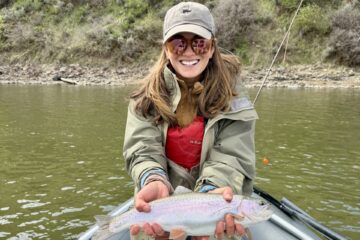
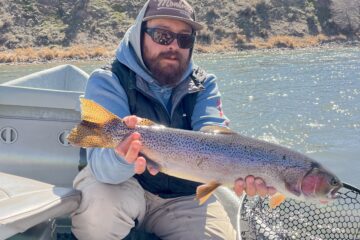
Recent Rainbow Trout Caught on the Gunnison River


Conclusion
The rainbow trout that inhabit the Gunnison River are truly unique and are paving the way for other fisheries to bounce back from Whirling Disease. The “Project Rainbow” short film does a great job of telling the story of these fish and I highly suggest you give it a watch.
However, the only true way to experience these special fish, is to visit the Gunnison River with your own two feet and witness the beauty of this wilderness and fight of these fish with your own two eyes.
We would love to guide you along this experience and show you what this area has to offer.
The best way to experience catching these fish in such an incredible location is to join us for a multi-day trip through the heart of the Gunnison Gorge.


0 Comments